

Skill Matrix for Teams, Labeling Relationships; AI FOMO, at what cost?
Issue #75 Bytes
🌱 Dive into Learning-Rich Sundays with groCTO ⤵️
Article of the Week ⭐
“Most teams guess who knows what.”
Building a skill matrix that actually helps your team
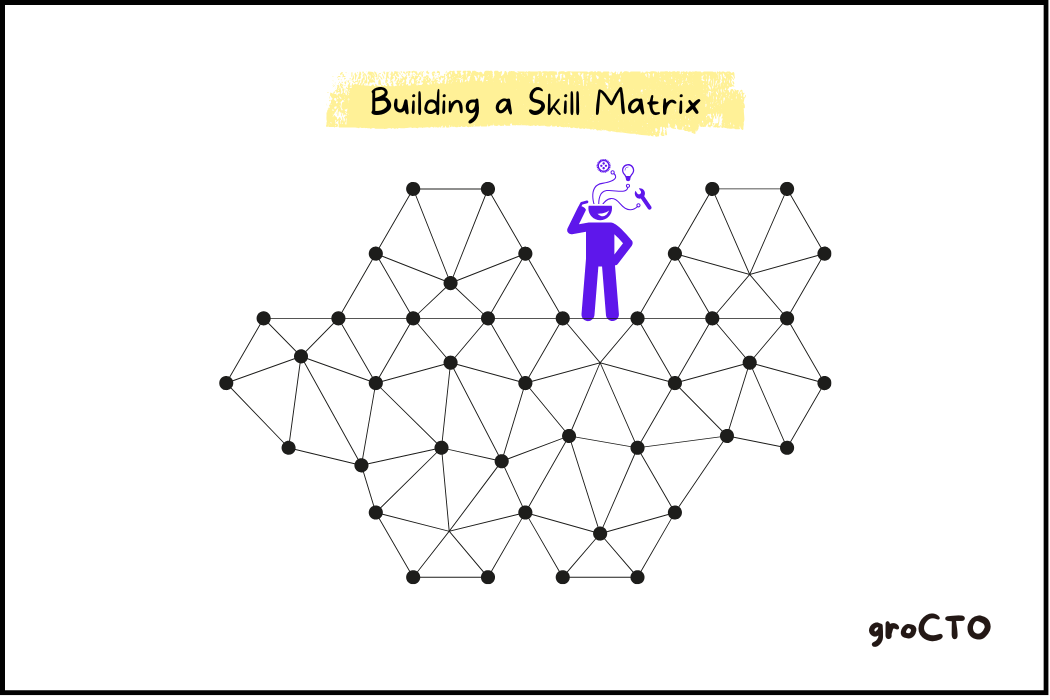
A skill matrix a shared map of real team capabilities that reveals hidden risks, gaps, and opportunities for growth. Sadly far too often in organisations skill maps end up being used merely as a career ladder or performance checklist. But it can be much more than that: a lens on how your team functions as a system. Emmanuel shares his prized experienced on how to build great skill matrixes:
Impact first
Understand today’s capabilities: who can realistically do what, and where single points of failure live
Anticipate future needs: what skills the roadmap demands and where your team needs to grow
Expose real working methods: what people actually do (e.g., how releases happen, how teams collaborate, SOPs)
Leaders who skip this clarification poison the exercise before it starts. People only answer honestly when they know the matrix is a team tool rather than a judgment device.
Your team is a system
Borrowing from systems thinking, teams have feedback loops, bottlenecks, and hidden dynamics that don’t show up when you look at individuals in isolation.
A good skill matrix exposes things like:
single points of failure
skills that never spread because the same person always does the work
areas the team keeps investing in that the business doesn’t actually value
critical capabilities the strategy depends on but nobody owns
Seen this way, the matrix becomes a diagnostic lens.
Three questions every useful matrix answers
Every effective matrix balances three perspectives at once:
Where we are now
Current skills, depth, and distribution, including uncomfortable realities.Where we think we’re going
The roadmap, the tech bets, and what the team wants to grow into.Where the organization needs us to go
Capabilities implied by strategy, regulation, scale, or market pressure.
The tension between these must be made visible to enable leaders to facilitate change and support difficult transition points in future roles and processes.
Levels without turning people into numbers
Emmanuel combines the Dreyfus model and Bloom’s taxonomy to describe growth in a way engineers recognize. Instead of the usual 3/5, it highlights opportunities scoped to:
what someone can do independently
what kind of decisions they can make
how much context they need
whether they unblock others
This makes calibration conversations grounded and far less political.
Process matters as much as the artifact
How you evaluate depends on trust:
In high-trust teams, peers evaluate first, then leaders calibrate.
In lower-trust or newer teams, self-evaluation followed by coaching works better.
In both cases, the matrix only pays off if it feeds back into:
training plans
pairing and mentoring
hiring decisions
initiative sequencing
A matrix that doesn’t change how work is planned becomes shelfware fast.
What you do after the matrix matters more than the matrix itself.
Used properly, it turns vague instincts into visible data:
when to slow down
when to invest in learning
when a roadmap is unrealistic
when expertise needs to spread
Investment into an actionable skill matrix helps teams stop relying on heroics and start growing capability on purpose. Seeing your team clearly enough to move forward without guessing is what allows you to keep a steady pace without burning out the same people over and over again.
Other highlights 👇
Why Labeling Relationships Is So Important
John Cutler’s point is deceptively simple for us this week: most “operating system” diagrams fail because they only show boxes, not the meaning between boxes. When you force yourself to label the relationships and the verbs, the whole system gets clearer fast.
He walks through a few common traps:
Goals ↔ initiatives aren’t one relationship. Different orgs treat goals as anchors, guardrails, post-hoc justification, or reporting buckets. Those are totally different worlds, and they drive totally different behaviors.
Two companies can draw similar “strategy → execution” charts but run completely different playbooks, depending on whether the edges mean “implements,” “constrains,” “learns from,” “feeds,” “localizes,” etc.
Hierarchy thinking fails at scale: A lot of “scaling agile” logic comes from copy-pasting team-level patterns upward (epic → program → portfolio, standup → big standup, OKR cascades), even though the dynamics change once politics, translation, and distance show up.
His lesson for us this week: model your org like a network, not a tree. Name the relationship types, ie. flow, accountability, constraints, feedback loops, translation because that’s where the real operating system lives.
It’s not a principle until it costs you money
Principles only exist when they constrain your choices. If a value never forces you to give something up, it isn’t guiding your behavior. Sergio argues that much of modern tech, especially the current wave of AI tooling, is no longer neutral in practice. It concentrates power, shapes behavior at scale, and quietly embeds values that many practitioners never agreed to.
Companies and individuals are being pulled into adopting and promoting AI tools less out of clear necessity and more out of fear of being left behind. That fear creates a market for easy money: consulting, training, and tooling sold on urgency rather than proven value.
When decisions are driven by panic and hype, principles are usually the first thing to get compromised. Money is leverage. Who you accept work from, what products you buy, and what systems you help scale are the strongest signals of what you actually stand for. For people who feel disoriented or disappointed by where tech is heading, reframing your “values” as everyday economic choices rather than abstract positions and words on the wall. Coordinated refusal may be more powerful than individual critique.
Find Yourself 🌻
That’s it for Today!
Whether you’re innovating on new projects, staying ahead of tech trends, or taking a strategic pause to recharge, may your day be as impactful and inspiring as your leadership.
Merry Christmas! See you next week, Ciao 👋
Credits 🙏
Curators - Diligently curated by our community members Denis & Varun
Featured Authors - Emmanuel Valverde Ramos, John Cutler, Sergio Visinoni
Sponsors - This newsletter is sponsored by Typo AI - Engineering Intelligence Platform for the AI Era.
1) Subscribe — If you aren’t already, consider becoming a groCTO subscriber.
2) Share — Spread the word amongst fellow Engineering Leaders and CTOs! Your referral empowers & builds our groCTO community.