Andrej Karpathy's CLAUDE fixes; Junior Engs in the time of AI; Big Tech Engineers struggling in Startups
Issue #90 Bytes
🌱 Dive into Learning-Rich Curation with groCTO ⤵️
Article of the Week ⭐
“A 65-line text file just became the most popular repo on GitHub. The reason it worked has very little to do with code.”
How Karpathy Solved the #1 AI Problem
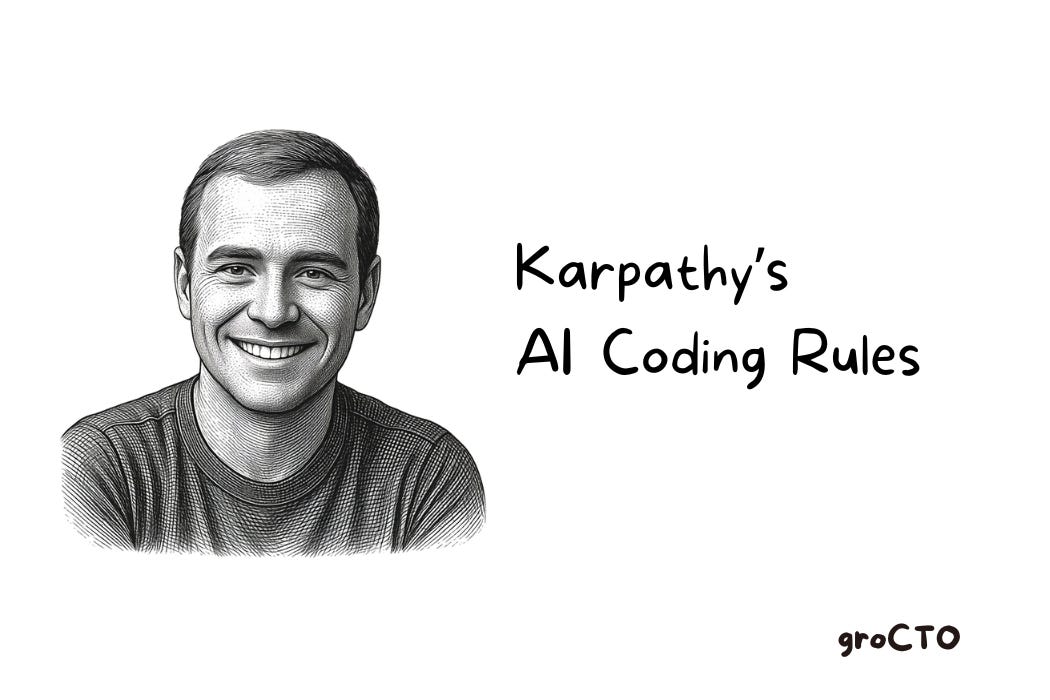
In January, Andrej Karpathy wrote that over two months his ratio had flipped: from writing 80% of his code himself to letting an AI agent write 80% of it. He wasn’t celebrating. He was cataloguing the failures: the AI assumed things, overcomplicated code, touched files it wasn’t asked to touch, stayed quiet when it should have pushed back. The day after, a developer named Forrest Chang turned the complaint into a 65-line text file called CLAUDE.md and dropped it on GitHub. It now has over 57,000 stars and 220,000+ combined forks, more popular than most agent frameworks built by full teams with millions in funding.
Think before coding. Don’t assume. If something’s unclear, stop and ask. If there are two ways to read the request, name them both. Push back when you should.
Simplicity first. Write the minimum code that solves the problem. No extra features. No “flexibility” nobody asked for. If you wrote 200 lines and it could have been 50, rewrite it.
Surgical changes. Touch only what you have to. Don’t “improve” the code next door. Match the existing style even if you’d do it differently. Every line you change should trace back to what was asked.
Goal-driven execution. Define what success looks like before you start. “Add validation” becomes “write tests for invalid inputs, then make them pass.” Vague goals make vague work.
Replace “code” with “report” or “email” and every rule holds. Most teams have never written these expectations down, for either the AI or humans. LLMs multiply what you already have: a culture that doesn’t ask why → still doesn’t ask why, but now with five agents running in parallel.
Serious AI users who reads the file has the same reaction: “oh, I should have been doing this the whole time.” That’s why it has 57,000 stars.
Other highlights 👇
AI didn’t kill your junior pipeline. You did
A junior developer complains about getting a job due to AI.
The first reply: “lol, companies still hire juniors?”
The second: “just use Claude bro.”
The post was deleted twenty minutes later.
Andrew Murphy’s argument: companies cut junior hiring based on conference vibes and memes, and are now pulling the ladder up behind themselves.
The math no one wants to do. Cut juniors now, short on mid-levels in 3 years, bidding war for seniors in 5 from a pool everyone stopped replenishing simultaneously. The people who made the decision won’t be around for the consequences.
Seniors atrophy too. One EM noticed his best backend engineer’s design docs getting thinner. He’d started routing every design decision through AI, skipping the deep thinking that built his judgement. Atrophy doesn’t announce itself. The muscle weakens so slowly you log it as getting faster.
The vendor risk. Your talent strategy now runs on companies whose pricing is currently subsidised. When it triples, you’ll have no juniors, degrading seniors, and no fallback. You’ve lost optionality.
Pairing. Pair juniors with AI tools as training accelerators. A startup Murphy advises has graduates outpacing mid-levels on code smell detection after 6 months of reviewing AI output. Update the job description; the role is still there.
What’s your justification?
Why Big-Company Engineers Struggle at Startups | Fredrik Wallenius, CTO, EsterCare
Fredrik Wallenius, Google, then Engineering Director at Tink (600+ employees, acquired by Visa) where he led a platform team supporting hundreds of engineers, now CTO at an early-stage Swedish health startup interviewed on what changes when you move from scaling to building from scratch.
Who thrives in the transition. Engineers who see nothing as “somebody else’s problem.” At a startup, the breadth is the job: some days it’s technical strategy, other days it’s buying a laptop for a new hire. Scope prestige is a liability.
What to build before you need it. Engineering ladders and performance reviews feel “boring and corporate-y” (Fredrik’s words), but without them expectations drift once headcount hits the hundreds. Consistent performance standards regardless of who your manager is, and a mechanism for managing poor performers before they become embedded.
The autonomous teams trap. Fully autonomous teams harden their boundaries, each develops its own agenda and loses contact with the wider org. Keep teams fluid: move people between them, let sizes grow and shrink with workload.
On distributed teams. Mix locations within teams rather than grouping by site. Co-located clusters create inter-team conflict. Cross-location composition builds the remote-first defaults by necessity.
“Kill your darlings.” Remove features and rebuild systems past salvation. Teams that can’t make that call end up maintaining everything in perpetuity.
Relevant for anyone managing org design across growth stages, or hiring from large orgs into smaller ones.
Find Yourself 🌻
That’s it for Today!
Whether you’re innovating on new projects, staying ahead of tech trends, or taking a strategic pause to recharge, may your day be as impactful and inspiring as your leadership.
See you next week, Ciao 👋
Credits 🙏
Curators - Diligently curated by our community members Denis & Varun
Featured Authors - Matt Watson, Andrew Murphy, Fredrik Wallenius (w/ Yassine Kachchani)
Sponsors - This newsletter is sponsored by Typo AI - Engineering Intelligence Platform for the AI Era.
1) Subscribe — If you aren’t already, consider becoming a groCTO subscriber.
2) Share — Spread the word amongst fellow Engineering Leaders and CTOs! Your referral empowers & builds our groCTO community.