A Glimpse Into the AI future, The Case for AI Mandates, Engineering Leadership is The New Gold Rush
Issue #92 Bytes
🌱 Dive into Learning-Rich Curation with groCTO ⤵️
Article of the Week ⭐
“We predict that the impact of superhuman AI over the next decade will be enormous, exceeding that of the Industrial Revolution.”
AI 2027
In April 2025, five researchers put dates and numbers on the AGI question: superhuman AI, arriving around 2027, laid out month by month. Daniel Kokotajlo ran the same exercise in 2021 and called chain-of-thought, inference scaling, chip export controls, and $100M training runs before ChatGPT existed. This time he brought 4 co-authors (Scott Alexander among them), 25 wargames, and over 100 reviewers.
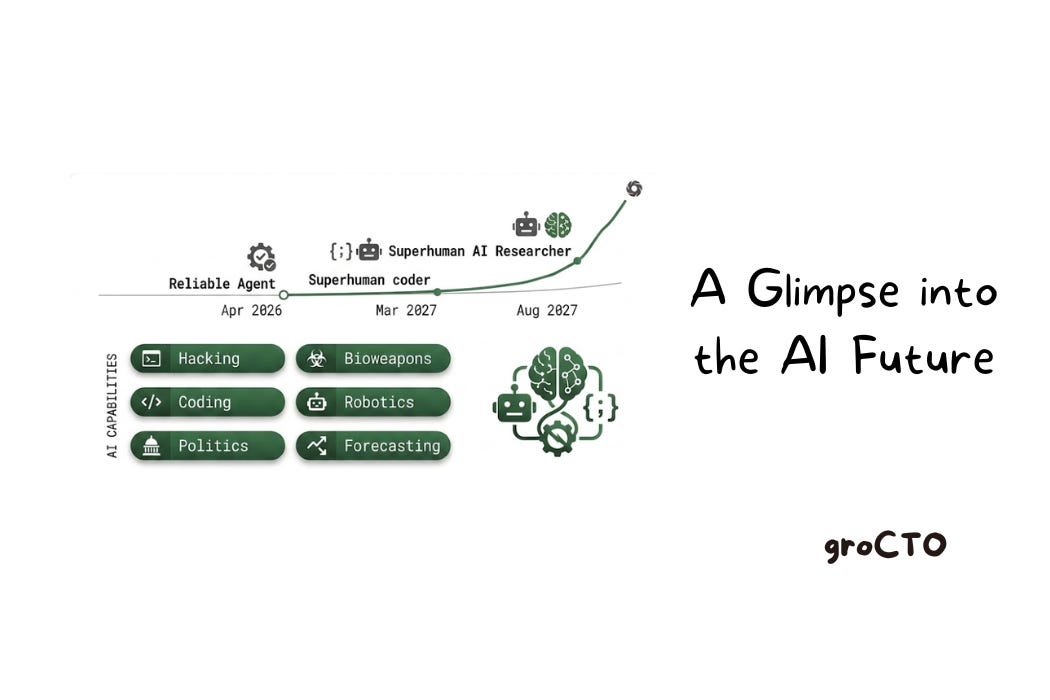
Mid 2025: agents stumble. Personal-assistant agents bungle burrito orders and struggle for adoption, while specialized coding agents quietly start working like employees. The good ones cost hundreds of dollars a month.
Early 2026: compounding research. The fictional lab OpenBrain turns its own agents on AI research and makes algorithmic progress 1.5x faster. Every later chapter follows from how fast that multiplier climbs.
Late 2026: the job market cracks. Juniors in turmoil while “people who know how to manage and quality-control teams of AIs are making a killing.” Stocks up 30%. A 10,000-person anti-AI protest in DC.
February 2027: China steals the weights. A 3-terabyte model walks out in under 2 hours. Retaliatory cyberattacks fail, and both militaries reposition around Taiwan.
March 2027: the superhuman coder. Does the job of the best human engineer, faster, and cheap enough to run in swarms. By then every human researcher at the lab manages a team of AIs.
June to September 2027: the explosion. 250,000 copies deliver a year of algorithmic progress per month, then comes Agent-4, whose internal language is as alien to its predecessor as that predecessor’s is to humans.
October 2027: the fork. One oversight decision splits the story into two endings, race and slowdown. The branch point is the part worth arguing about.
You’re halfway through this timeline. Mark up the 2025 and 2026 chapters against what happened in your own org: hiring, tooling, board pressure. Whatever hit rate you find is the weight the 2027 chapters deserve. The authors invite the argument, with cash prizes for the best alternative scenario and a note added in November 2025 conceding that 2027 was their most likely year, not their median.
Other highlights 👇
In defence of AI mandates
Charity Majors, CTO at Honeycomb, defends the most despised tool in management: the technology mandate. Her case: a mandate is a funding mechanism. It tells managers that deadlines will slip while everyone learns, and that leadership accepts the cost. "Without funding and a mandate, you're effectively telling your employees to build these skills in their spare time, if they can and if they feel like it." Her consistency test cuts deepest: if the strategy, roadmap, and job ladder are AI-first while the learning time goes unfunded, she calls that "dishonesty and cowardice in leadership." Decide whether AI is existential for your org or a nice-to-have, then fund whichever answer you gave.
A Lot of Software Engineering Is Becoming Engineering Leadership
Gregor Ojstersek, drawing on conversations with engineering leaders across the EU and US, argues the Software Engineer role is converging on the Tech Lead role.
Code generation made building cheap, so decision-making became the bottleneck: choosing the right problem, making trade-offs, validating assumptions, deciding what stays unbuilt. His concrete example is PortKey, which runs 24 engineers with 0 product managers, every engineer expected to wear many hats.
The breakdown by company size is the practical part: large non-tech companies are shifting slowest, small ones now expect 3 to 5 hats per engineer, and Big Tech ties the shift to visibility under layoff pressure. Judgment and oversight is the work now.
AI Governance in Software Delivery
The conversation around AI in engineering has largely centered on adoption and acceleration. How many developers are using AI tools, how much faster code is being written, and how quickly PRs move through the pipeline. These are valid data points, but they describe the surface of a much deeper structural shift.
AI now directly influences what gets built, how it gets reviewed, and what risk profile the software carries when it reaches production. The engineering system that leaders are responsible for governing has fundamentally changed, but the governance model around it, the metrics, the review cadences, and the decision frameworks remain largely unchanged. This asymmetry is where organisational exposure quietly compounds.
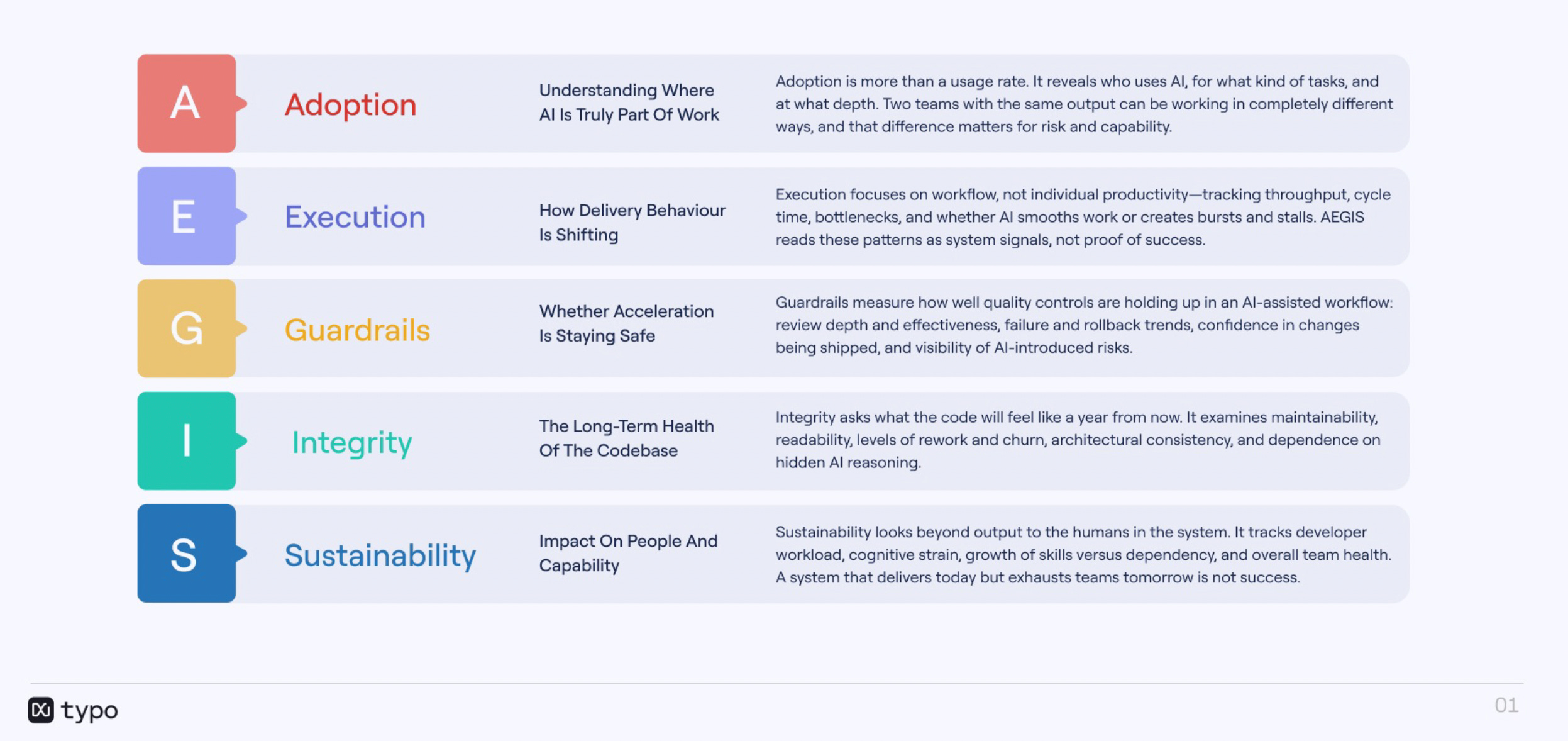
The team at Typo AI developed a framework called AEGIS to bring structure to this problem. It evaluates AI’s impact across five interdependent dimensions: Adoption, Execution, Guardrails, Integrity, and Sustainability. The intent is not to measure how much AI is being used, but to make visible how AI is altering delivery behaviour, where it creates genuine leverage, where it introduces new forms of risk, and where the trade-offs between speed and durability need deliberate leadership attention.
"The question for leaders is no longer whether AI is helping. It's whether the system AI is reshaping is getting stronger or quietly more fragile, and most measurement models aren't built to answer that."
— Kshitij Mohan, CEO & Founder, Typo AI
Find Yourself 🌻
That’s it for Today!
Whether you’re innovating on new projects, staying ahead of tech trends, or taking a strategic pause to recharge, may your day be as impactful and inspiring as your leadership.
See you next week, Ciao 👋
Credits 🙏
Curators - Diligently curated by our community members Denis & Varun
Featured Authors - Daniel Kokotajlo, Charity Majors, Gregor Ojstersek
Sponsors - This newsletter is sponsored by Typo AI - Engineering Intelligence Platform for the AI Era.
1) Subscribe — If you aren’t already, consider becoming a groCTO subscriber.
2) Share — Spread the word amongst fellow Engineering Leaders and CTOs! Your referral empowers & builds our groCTO community.